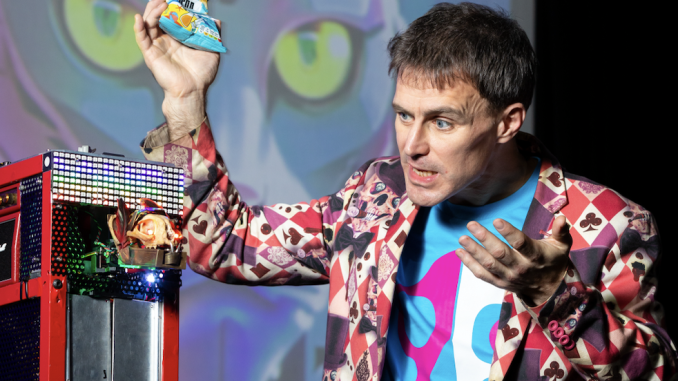
This morning, performer and technologist Robin Wealleans will appear at Aberystwyth Magistrates Court, where he intends to defend himself in an unprecedented way. In what is a world first, Robin has relied on his custom AI alone to structure his defence over several weeks and will use it to deliver his opening statement and help to respond to any court queries.
His unique system, called CatGPT (@CatGpt Pro) is an OpenAI-based model he built as a tribute to his much-loved cat Lentilwho died in 2016, an affectionate animal whose personality he describes as unusually kind and grounding. The model has been central to the development of his touring comedy/theatre show and now plays a central role in the legal strategy for this case.
Although his solicitor will be present, Robin has made clear that legal counsel will serve only as a safeguard rather than the primary advocate. His aim is to demonstrate how neurodiverse people can use technology to navigate systems that often disadvantage them.
The charges relate to low-level motorway speeding and subsequently driving while unknowingly disqualified, circumstances that resulted from his neurodiversity related difficulty opening post.
Both cases were heard in his absence, one while he was in Japan and the second one despite requesting an adjournment. Had he known he was facing a ban he could’ve made a Special Reasons argument and likely won on several points and retained his license anyway.
Robin’s career has long been shaped by unconventional thinking. A stand-up comedian known for improvisational, object driven shows, he first performed at the Edinburgh Fringe rather than starting on the pub circuit and has since taken his work to major festivals in New Zealand, Adelaide and Japan. His debut global tour, titled CatGPT : 13 Lives kicks off on February 13th 2026 and will take in 13 countries all across the globe.
He organised all of this with the aid of CatGPT and hopes to break several records in the process. CatGPT emerged from his keen inventive streak, with the system forming the backbone of what he and others have described as one of the most technically advanced comedy shows ever produced. It incorporates modular synthesisers, projection, object recognition and an expansive narrative world developed around his cat’s imagined memories and personality. This experimental work has attracted attention from high profile figures in entertainment and live production and gained high-profile media coverage.
Robin’s previous career in the arts and technology also led him into close proximity with a number of major music figures. He has worked behind the scenes at large concerts and festivals, including Glastonbury, Reading & Leeds. In 2005 at Live8, he worked on Pink Floyd’s reunion, watched by an estimated two billion. In 2008 he supplied the backdrop for Jay Z at Glastonbury and helped artists like Calvin Harris, Andy C and Squarepusher make an impact. Al Ashford, Audio, Visual MIDI programme for fellow comedian Bill Bailey, the show as “captivating and intriguing that is brining joy to so many.”
Despite these achievements, Robin often describes himself as someone who struggles with the administrative structures that underpin daily life. In the transcript, he discusses the impact of neurodiversity, PTSD and the recurring consequences of missing official letters. This difficulty with post is central to Thursday’s hearing. Having waited over 3 years for an NHS assessment he was unable to get an initial private one until December 22nd.
Robin commented:
“I appreciate this is not the usual way to appear in court, but this has been adjourned for the fifth time and the courts have much more pressing matters to deal with. Opening post has always been my kryptonite, and if the system insists on sending life altering information to a man who breaks into a cold sweat at the sight of an envelope, then they can hardly be surprised when things go sideways. CatGPT was meant to be a theatrical comedy project, not my legal representative, but at least he doesn’t panic, or judge me for my filing system. If he can help me explain how neurodiverse brains work, and if it stops anyone else ending up in this position, then he’s already earned his electronic treats.”
“The previous duty solicitor advised me to plead guilty for something I did not do. It has really affected me, I missed the chance to say goodbye to two friends at two funerals and countless missed opportunities. How much cost and time has all this wasted, in a case where anyone wired normally would’ve had four points and a speed awareness course at worst? I have utter faith in being heard by local magistrates where CAT GPT will give an opening statement on my behalf in plain relatable language, including some Welsh. We have written it together and I’ve found this a much more useful and understanding way of trying to state my complex case. I am doing this despite the fact that I could in theory be imprisoned for driving while disqualified or contempt of court just before Christmas and a world tour. It is of course up to the Magistrates how they wish to proceed.”
“Around 15% of people are neurodivergent yet they are estimated to be at least 50% of the prison population. Among artists that figure rises to at least 70% and includes Leonardo Da Vinci, Jimi Hendrix and Florence Welch. The disproportionate numbers partly reflect a system that doesn’t understand their needs or how to communicate with them. I am doing this on behalf of all those who think differently as well as those who cannot afford representation at all or simply do not understand the arcane legalese spoken in their name.”
As he was preparing for this week’s case he received further news that would break most people – a second much worse case emerged.
“Just this week Barclays and TLT Solicitors began proceedings against me to repossess my house of 25 years despite it being 97% paid for and a payment plan being under negotiation. This despite me explaining my PTSD and asking them to always call or email me in important matters and asking them to deal with my solicitor on my behalf. I made a goodwill payment and requested an adjournment but neither me nor my solicitor have received any update until today, further to my adding stress and PTSD. I am pleased to say it is now being resolved.”
Angela Bird, his support worker from Mencap, offered the following statement as she is currently unwell and will not be able to attend the hearing tomorrow:
“Robin’s situation is sadly familiar. Many neurodiverse people struggle because systems are not designed for the way their minds work. Robin has always been open about how overwhelming written communication can be for him. What looks like a simple envelope can trigger panic or complete avoidance. His case shows how easily someone can fall through the cracks without ever intending to break the law. What makes Robin exceptional is that he is turning his struggles into something constructive. By using an AI he built from a place of love and memory, he is showing there are new ways for neurodiverse people to be heard. I fully support him and admire his courage.”
Renowned Manchester University particle physicist and professor Jeff Forshaw comments:
“I am full of admiration for Robin and his creation CatGPT. Lentil and I have had fun discussing ideas in quantum physics on stage in Manchester and Cheltenham Science Festival. Robin has succeeded in creating something entirely original and important.”
Writer, comedian & co-host of The Infinite Monkey Cage Robin Ince writes about Wealleans in his best-selling book on autism Weirdly Normal and Normally Weird,
For Robin the issue is not creativity but the paperwork it might entail. It is the speed in which a neurodivergent mind can say, “sorry but I am not aligned to deal with instruction manuals or documents for registering things and that includes registering my show for a festival”
Robin’s hearing is scheduled for Thursday morning at 10.00am in Aberystwyth Magistrates Court, a building he ironically notes he once advised on during it’s creation.
Come and meet Lentil (L3NT1L)
CatGPT is available for pictures and interviews in person today from 12-3pm at:
Sapience Communications
2 Television Centre
101 Wood Lane
London W12 7FR
Notes to Editors
For more information, please contact:
Sapience Communications
Louisa Nairne, Padma Sarojar and Jonathan Batchelor
E: lnairne@sapiencecomms.co.uk / ps@sapiencecomms.co.uk
T: 020 841 7610