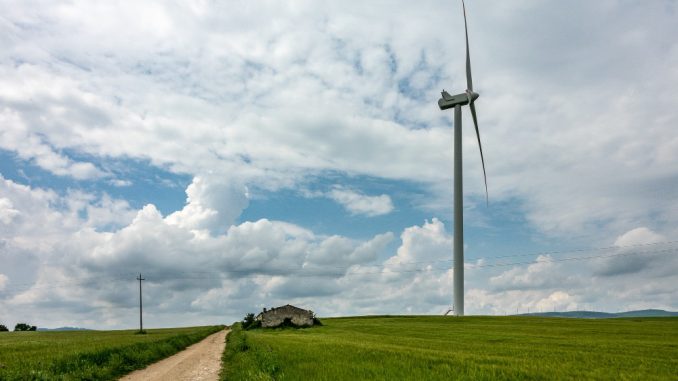
CPRW, The Welsh Countryside Charity, has warned that Wales’ renewable energy transition must better protect rural landscapes and secure the support of local communities.
As the single greatest threat to the Welsh countryside, working to address climate change and mitigate the impacts of climate change is, of course, a priority. Renewable and low carbon energy generation will play a pivotal role, and support for the industry is welcomed, but it is essential that this is done in a way that doesn’t destroy the very things we seek to protect and maintains the social licence from the public.
The current approach of the Welsh Government is not working as they have not achieved buy-in from the communities most impacted. These communities are not, in general, climate change deniers or anti-renewables activists; they are simply against the way major change is being imposed upon them by a government which “knows best”, to primarily benefit financial investors, often from other countries.
In setting a new deal with the renewables industry, the Welsh Government needs to:
· prioritise offshore wind, not only in the Celtic Sea, but also the vast areas of the Irish Sea off north Wales, where ultimately the majority of Welsh-generated renewable electricity will come from
· demand that the distribution grid is upgraded as soon as possible to unlock the potential and enthusiasm for local and community solutions, and direct the industry to genuinely work with communities
· apply the excellent policies they already have to protect landscapes, wildlife, habitats and agricultural land
By 2050 it is likely that Wales will be generating three times the amount of electricity currently produced, to power homes, businesses, public transport, heat pumps and electric vehicles. Over 80% of this will come from offshore wind turbines, with the power taken to where it is most needed by subsea cables. Both the Irish and Celtic Seas have immense resource potential. The offshore wind industry can become a major employer in both north and south Wales. The ports of Milford Haven, Port Talbot, Mostyn and Holyhead can be thriving hubs of industry for construction, assembly, operation and servicing of the offshore power stations. The Welsh Government must make this industry a priority.
Rural communities are naturally “self-contained”, accepting of developments that will bring them clear tangible benefits, but are rightly angered when told they have to have a renewable power station placed in their midst where the power will be taken away to be used by others. The distribution grid is holding back farm, village and community schemes that would be readily accepted, while the transmission grid, and connections to it, is being used to exploit rural areas while not delivering a single kWh to anyone who lives nearby. Renewable schemes that connect to the distribution system, generating electricity that will be used locally and can lower bills for the people who live near them, are needed. The Welsh Government needs to hold off its grand spatial plans for mass industrialisation of the countryside and facilitate bottom-up development. There is no need for anywhere in Wales to produce more electricity than it consumes, as vast offshore wind farms can always make up any deficit.
Wales already has some excellent policies to protect landscapes, habitats, wildlife and agricultural land, but time and again these are being ignored and overruled in the mad dash to generate as much as possible, primarily to benefit outside investors. Overwhelming need keeps being cited by the government as the reason to ignore its own policies. The Welsh Government needs to be clear with the industry and regulators that policy “red lines” will be adhered to, and not allow itself to be bullied into allowing anything, anywhere.
Jonty Colchester, Chair of CPRW, said: “It is well known that Wales is currently a net exporter of electricity due to large gas power stations, and will remain so due to growth in renewables. However, ironically, this actually increases bills for consumers in Wales, as we get no benefit from producing an excess and pay to send it over the border.”